DarkFi's v0.3 alpha testnet
Today we are releasing a new version of the DarkFi proof-of-work (PoW) alpha testnet. This milestone leads us another step toward the future we have envisioned. Anonymous, uncensored and sovereign: the future we were promised but don't yet have.
The main changes over the previous testnet version are:
- User smart contracts deployment
- Merge mining with
p2pool - Improvements to all testnet-related native applications
- Bug fixes and improvements from the previous testnet
- P2P network hardening and improvements
All other areas have also seen substantial work.
User Smart Contracts Deployment
Building on the smart contract foundation from our previous testnet, this release delivers the complete tooling and documentation needed for users to deploy custom contracts. With this release, we're introducing full support for deploying user smart contracts. Users can now create their own custom smart contracts, deploy them on the DarkFi testnet, and interact with them. An example smart contract deployment guide is provided to make users familiar with the process. The full deployment native smart contract spec can be found here.
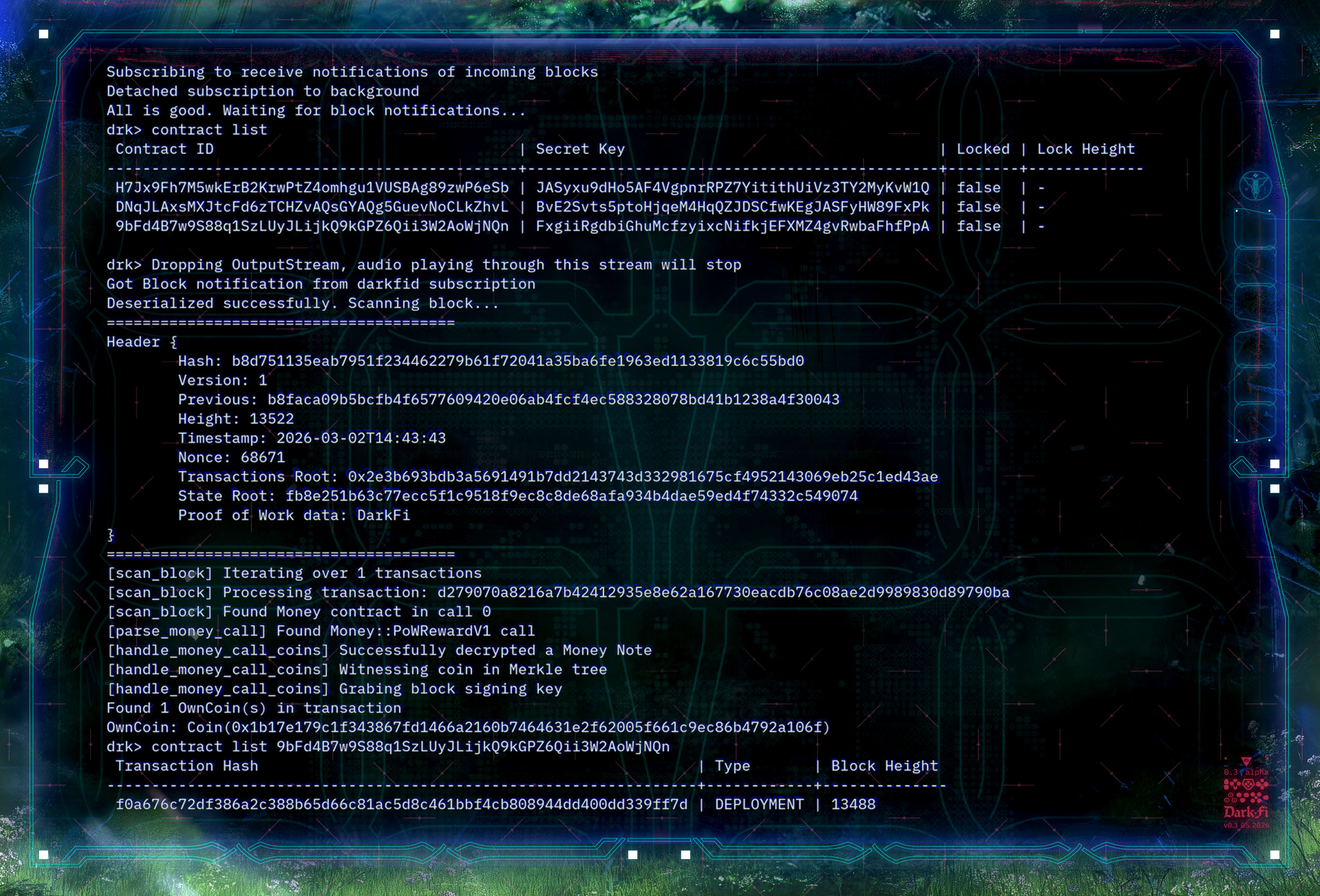
Deploying a custom smart contract
Merge Mining
In the previous release DarkFi promised to introduce merge-mining with
Monero. With this release, we are delivering that promise. Users are
now able to configure their darkfid instances to accept
requests from p2pool in order to merge mine Monero and DarkFi blocks,
giving us all the benefits of anonymous peer-to-peer mining without the
security risk that comes with bootstrapping a brand new
blockchain. Fun fact: you can also merge mine rewards direct into a
DAO treasury!
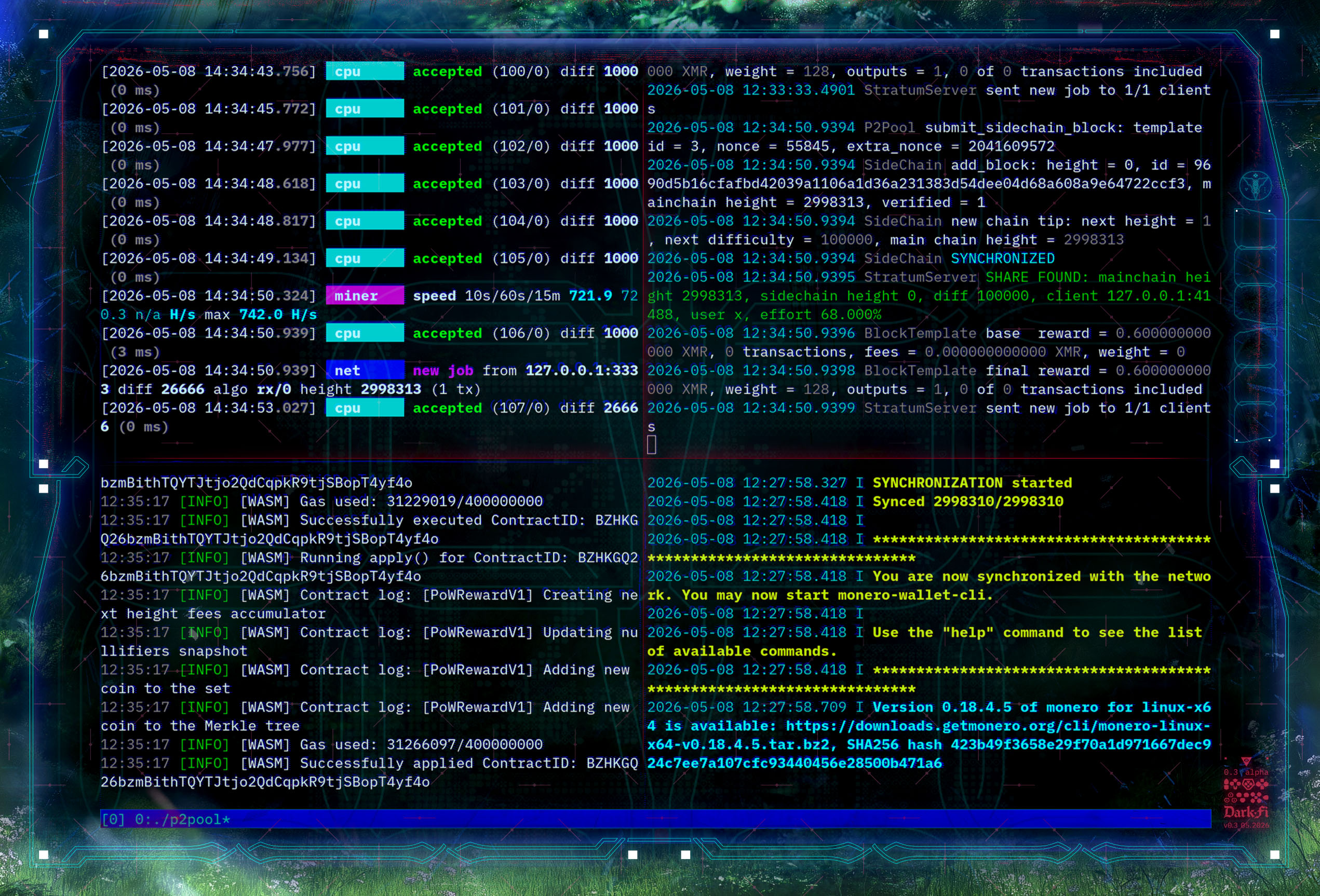
Merge mining on DarkFi alongside a Monero node
Native applications
All testnet-related native applications have been updated with bug fixes found during the previous testnet. We also introduced new functionality after extensive testing.
darkfid
The main daemon for the DarkFi network has been made more efficient, with
faster block verification times and improved communication with miners.
darkfid is now only responsible for consensus, acting as a server
where mining clients like xmrig and p2pool connect to request new
blocks to mine. Syncing, reorg and transactions validation handling
have all been improved to ensure daemon and network stability.
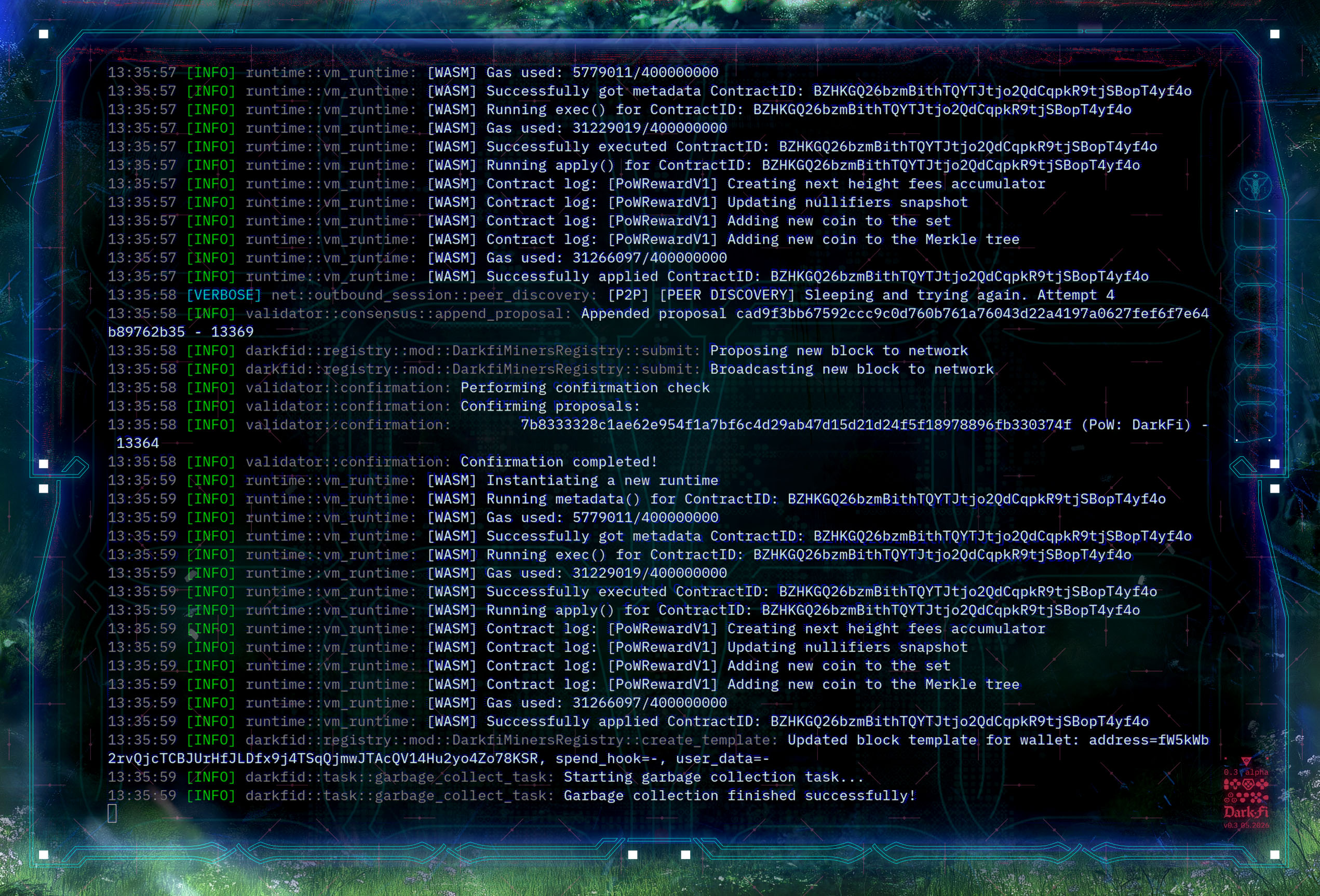
The main DarkFi blockchain node: darkfid
minerd
In our previous release, we introduced minerd, DarkFi's native mining
RandomX miner implementation. During the course of this update, the
communication logic between darkfid and miners changed and minerd
became solely responsible for mining DarkFi native blocks.
After many optimizations, we found that minerd was operating at
a disadvantage relative to xmrig, the industry standard RandomX
miner implementation. Because of this, we decided to replace minerd
with xmrig directly. This levels the playing field, both in terms of
performance and miner experience.
Miners don't have to use and maintain another piece of software. They
can now use their trusty xmrig daemon to mine blocks for DarkFi, using
their existing optimized configurations for their mining machine(s). All
they have to do is configure it with their DarkFi mining wallet address
to receive block rewards, and it will request new blocks from darkfid
to mine, as described in the miner documentation.
Implementing our own native mining daemon was a great experience and
gave us invaluable knowledge on the inner workings of RandomX,
making the decision to sunset it bitter-sweet. We value performance
over everything, always aiming to deliver the highest quality
possible, and we believe this change is for the better for both our
miners and the network as a whole.
RIP sweet prince!

drk
The command-line client for darkfid was greatly improved in both
performance and user experience. Scanning logic is now more efficient,
since we only store wallet-relevant information. We introduced a new
wallet address structure with a network prefix, allowing users to quickly
identify mistakes when interacting with foreign wallets. We also added
an interactive mode that makes the tool behave like a standalone shell,
greatly improving user interaction experience. All other minor bugs have
been fixed, and all features stabilized.
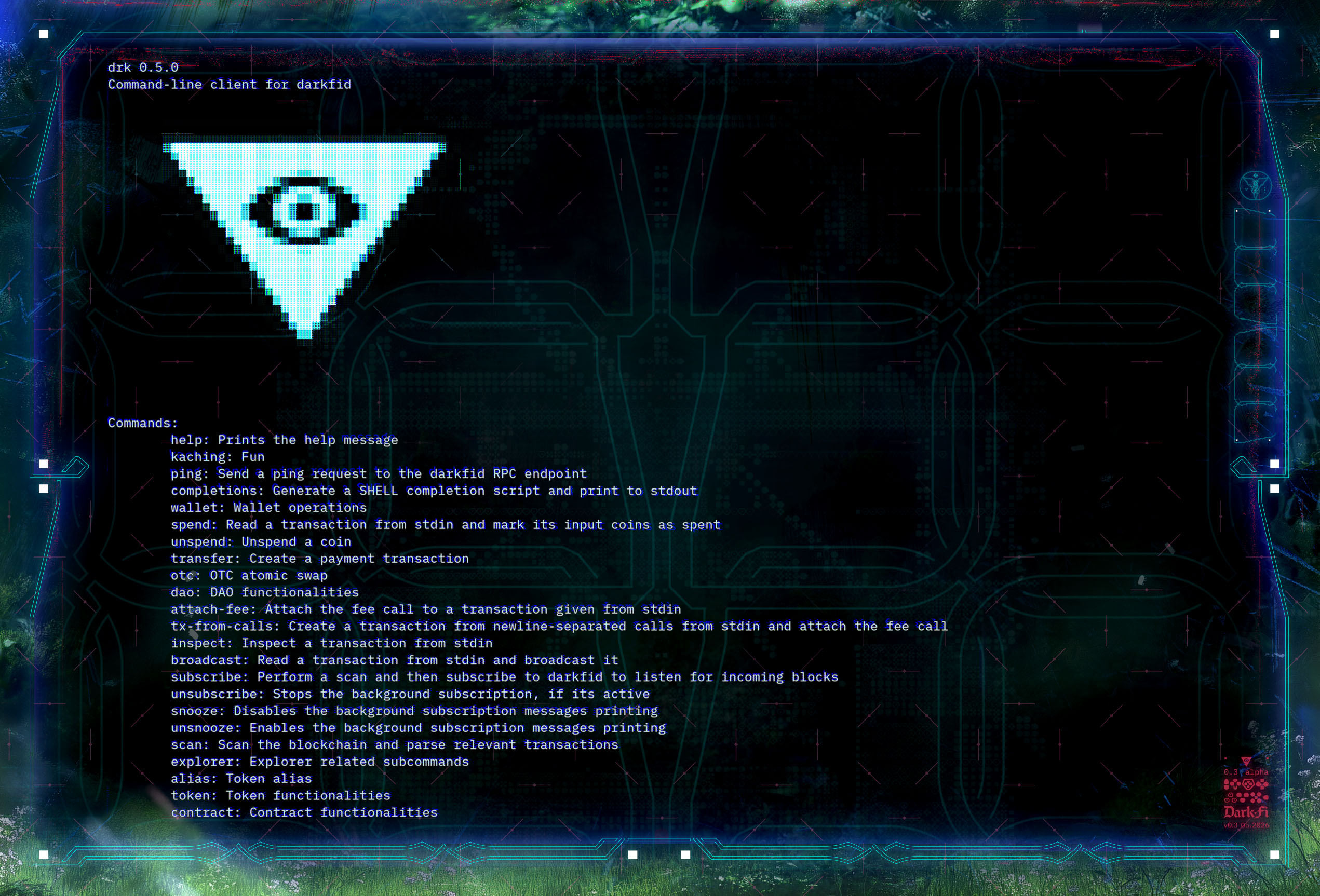
drk command line client & wallet tool. Here we can see subcommands for issuing tokens, DAO, atomic swaps and transfers.
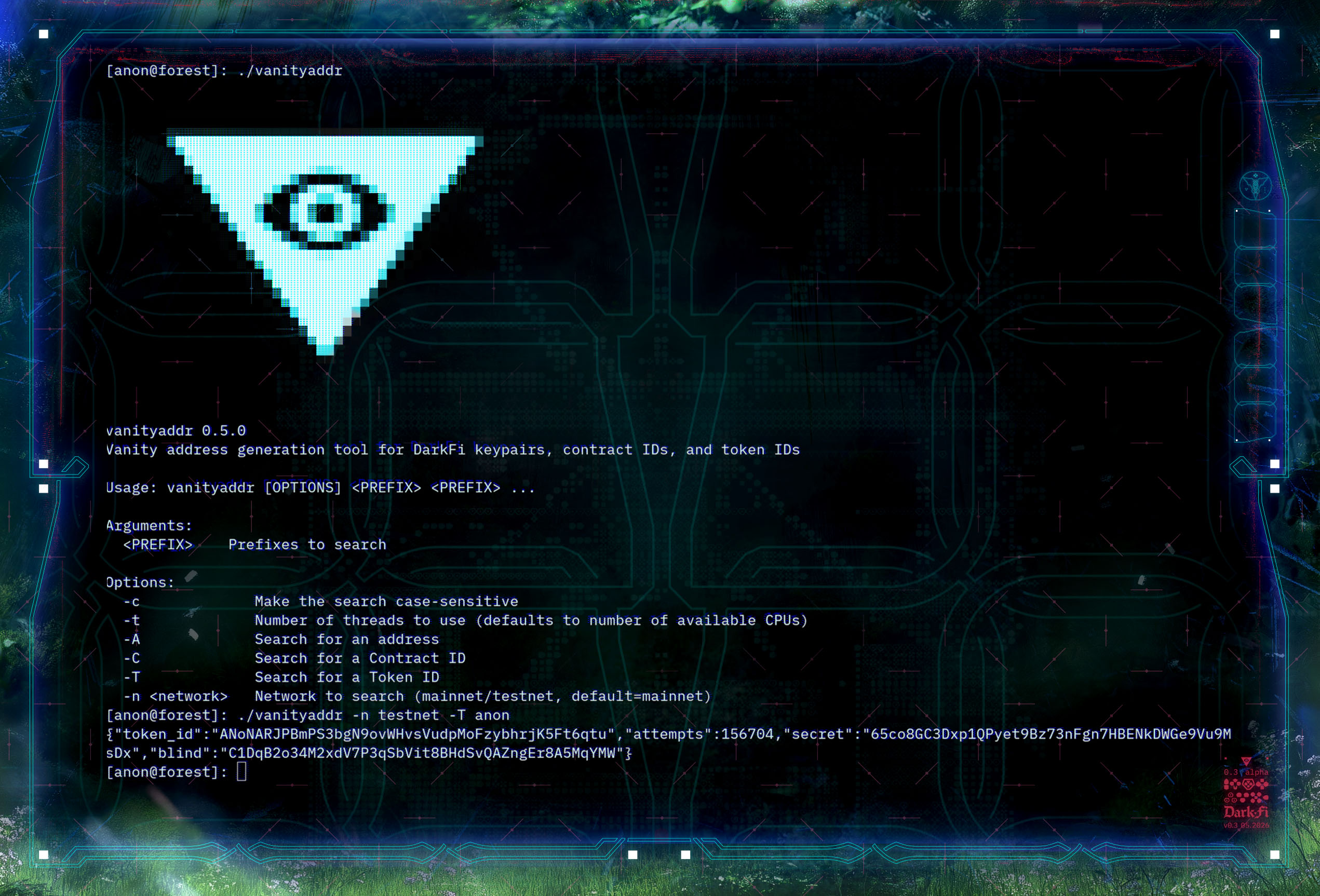
Vanity Addresses
The vanityaddr tool has been updated to use the new address format.
Fixes and improvements
Building on the previous testnet, this release incorporates comprehensive fixes and improvements.
Contracts State Monotree
DarkFi uses an optimized Sparse Merkle Tree implementation called Monotree to verify contract state after each block insertion and create proofs committing to that specific state. In the previous version, the global state tree contained the checksum of each contract state. In this version, each contract has its own Monotree containing all its hashed records, while the global tree is constructed using all contract state Monotree roots, along with the wasm bincodes Monotree root, excluding native contracts zkas tree and wasm bincodes. Further information is available here.
Transaction-local state
DarkFi DEP0008 was implemented, allowing users to define immediately spent coins on subsequent calls. Without it, transactions executing this kind of flow would potentially fail, since the Merkle inclusion proofs of such spent coins were verified against the global tree’s state, which depends on block ordering.
Blocks PoW verification
Nodes now use a cached key with their virtual machine(s) to verify
RandomX PoW on each block. The key is selected as the hash of a block
in the blockchain, called the key block. The key changes every 2048
blocks (~2.8 days) with a delay of 64 blocks (~2 hours) between the
key block and the key change, as per RandomX
recommendations. This greatly improves block verification time,
and reduces overall sync times.
ZKVM Runtime
We increased the default WASM virtual machine stack size and removed
the external wasm-strip dependency, allowing the use of the latest
stable Rust version.
Anonymous DAO Smart Contract
We fixed a bug where building a propose or vote transaction while
holding multiple governance tokens resulted in missing signatures.
ZK Tooling Enhancements
The DarkFi python SDK has been updated to the latest pyo3
version with complete bindings introduced, along with a full usage
example.
P2P network upgrades
In this release, we focused on stabilizing the P2P module by introducing required upgrades and fixing issues found during the previous testnet.
Transports improvements
We improved both transports mixing and socks5 proxy setup to allow
for easier configuration. With these additions, nodes running over
nym are supported.
DoS Protections
The P2P module's existing DoS protections are now applied to all native application protocol messages, allowing applications to restrict traffic flooding and further protecting nodes from malicious attacks.
Version Message Info
We implemented DarkFi DEP0001, allowing nodes to immediately drop a connection if the protocol version is incorrect. In practice, this means nodes will now drop connections with other nodes if their application versions mismatch.
Network Profiles
We implemented DarkFi DEP0007, allowing for much more refined network configuration. Each supported transport now has its own configuration profile that can be configured individually.
dnet
We stabilized the Python-based tui by fixing all minor bugs that were found.
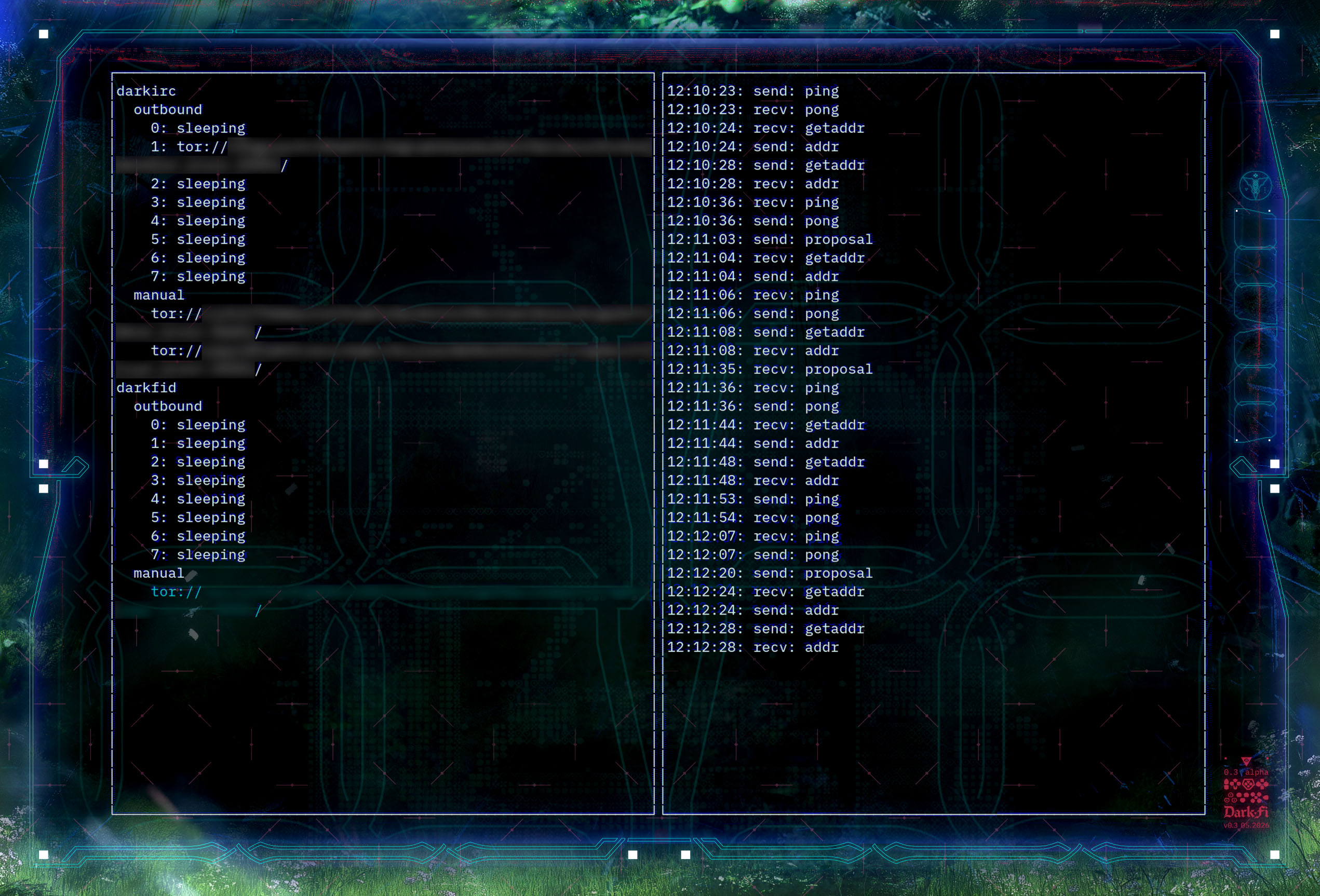
Visualizing DarkFi P2P networks with the dnet tool
Enter the Dark Forest
Explore the current testnet via our deployed blockchain explorer. Updates and upgrades on DarkFi PoW alpha testnet will be published on DarkFi insights and on our social channels. Future upgrades will include alternative storage options, wallet integration into the GUI application, fully fledged fees and block rewards implementation, and many more apps and use cases.
DarkFi is providing the tools for the sci-fi future we were promised — without compromise. We build privacy-preserving tools using the tools that protect our rights and the freedoms of every user of DarkFi.
DarkFi is built by anonymous developers using P2P anonymous software.
Want to contribute? Join us.